What Google unveiled at NRF 2026
Stat | Detail |
|---|---|
Jan 2026 | UCP unveiled at NRF |
16 Tech Council seats | 5 founding + 5 added on Apr 24 (Amazon and others) |
3 stages | Discovery → Buying → Post-purchase |
In his NRF 2026 keynote, Sundar Pichai declared that “the agentic shopping era has begun,” and opened UCP as an open standard. He argued that Gemini and Google AI Mode need to unify product discovery, comparison, payment and post-purchase support into one flow and that an open protocol where retailers, platforms and payment networks all speak the same language is required to make that possible.
Google Cloud frames it as “a common language for agents and systems to operate together, from discovery through purchase and after-sales.” In other words, UCP sits one layer above general tool-call standards like Anthropic's Model Context Protocol (MCP) or OpenAI's function calling, adding the full commerce-domain transaction rules on top. (Sundar Pichai - NRF 2026 Remarks, Google Cloud - A new era of agentic commerce)
Why this is an inflection point
The grammar of digital marketing for the past decade was a click-based funnel: a click happens on a SERP, conversion happens on a landing page. That assumption is breaking down. Traffic analysts like Similarweb and SparkToro already report that more than half of searches globally now end as zero-click searches because Google AI Overview, ChatGPT Search, Perplexity, Claude and Microsoft Copilot deliver the answer directly.
Up to here, this was “AI search shaking SEO.” UCP's launch marks the next step from AI giving an answer to AI executing the transaction. Agents like Gemini and ChatGPT already know the user's tastes, budget, shipping address, payment methods and loyalty memberships, so a single conversation closes the purchase. For brands, three implications follow.
Retail media (ads) shrinks in importance. Because the agent knows user context better, search ads matter less and the quality of the reason to recommend becomes the key.
Product data consistency equals revenue. Variant, inventory or price drift, and the agent simply excludes the brand from recommendations.
Brand AI legibility becomes an asset on its own. “How many AIs mention us, and how accurately do they describe us” turns into a measurable KPI. That is GEO's reason to exist and the first ticket into the UCP era.
Related reading: Five conditions for the zero-click era and What is GEO?.
UCP at a glance: the agentic commerce lingua franca
The Universal Commerce Protocol (UCP) is an open spec for AI agents to exchange retailer product, inventory, pricing, order and customer-identity data in a standardized way. Technically it's composed of REST APIs with MCP (Model Context Protocol) bindings, OAuth 2.0 authentication and the AP2 (Agent Payment Protocol) payment layer — connecting to UCP-compatible payment networks including Google Pay. Through gradually-released UCP onboarding inside Merchant Center, brands gain the ability to receive direct buying inside Google AI Mode and Gemini. (Google for Developers — UCP Guide, Google Pay — UCP Overview, Google Developers Blog — Under the Hood: UCP, ucp.dev)
Element | What it defines | Brand implication |
|---|---|---|
Checkout | Closing a payment inside the AI answer (Google Pay and other UCP-compatible payment rails) | The goal moves beyond being recommended to being chosen |
Identity Linking | Connecting the logged-in customer's loyalty, membership and coupons inside the UCP flow | Member benefits persist inside the AI conversation |
Order Management | Order status, shipping, refund and exchange flows that the agent can query and act on | CS and order API consistency drives re-purchase and LTV |
Catalog (optional) | The contract by which the agent queries variants, inventory and pricing in real time | Product data freshness and consistency become competitive edges |
Trust & Safety (cross-cutting) | Authentication via OAuth 2.0 + AP2 (Agent Payment Protocol), payment fraud prevention, dispute resolution | Brand reputation and payment trust are prerequisites |
The April 2026 update brought Catalog enhancements, broader Identity Linking support and simplified onboarding — a signal that UCP is evolving from announcement specification into shipped product. (Google Blog — New tools for retailers in an agentic shopping era, Google Blog — UCP updates)
The early partner map: who lined up, and how
UCP's initial partner lineup tells you the intent. Looking at the founding Tech Council members (excluding Google): Shopify is effectively the global standard for D2C and e-commerce, Etsy represents long-tail products from artisans and individual sellers, Wayfair stands for the home and furniture vertical, and Target represents integrated U.S. offline-and-online retail. Add in ~20 endorsers - Walmart, Adyen, American Express, Best Buy, Flipkart, Macy's, Mastercard, Stripe, Home Depot, Visa, Zalando, and others - and the alliance is built to ensure UCP becomes an industry-shared spec rather than a Google-only one. The presence of all three big payment networks (Visa, Mastercard, American Express) is especially important, it signals that the existing financial infrastructure stands behind the biggest agentic-commerce risks: payment fraud and dispute resolution.
The most practically important observation from a Korean perspective is that Shopify and Etsy are in. Korean D2C brands built on Shopify are highly likely to be brought onto the UCP path simply through platform updates. Korean platforms like Cafe24, Imweb, NHN Commerce and Makeshop aren't on the initial partner list, but because UCP is open spec, they're likely to follow via Merchant Center feeds and Schema.org structured data on a similar trajectory. The thing that matters isn't which platform you're on — it's getting the product data layer the agent can read in order first.
Amazon's walled garden + the April UCP Tech Council move
Update — April 24, 2026
Amazon, missing at the NRF launch, has now officially joined the UCP Tech Council alongside Meta, Microsoft, Salesforce and Stripe. With the original founding members (Google, Shopify, Etsy, Target, Wayfair), Council seats have expanded to 16, and the Council governs protocol direction and codebase decisions. The early picture of “Amazon is staying out of UCP” has already broken — Amazon is running a two-track strategy that pursues its own walled garden and the UCP standard at the same time.
Sources: Newsfile — Amazon·Meta·Microsoft·Salesforce·Stripe Join UCP Tech Council, ucp.dev — Official UCP site
That doesn't mean Amazon scaled back its own agent line. Where Google chose “build ecosystem consensus through an open protocol,” Amazon chose “sit at the UCP table while also being its own agent and retailer” — keeping its walled garden in parallel. Its line that closes shopping queries, payments and CS inside Amazon's own AI assistant, locking traffic, data and payment fees inside its own ecosystem, is being reinforced — and is materializing along three axes.
① Rufus: the in-app and on-web AI shopping assistant
Rufus is the generative and agentic AI shopping assistant integrated into the Amazon app and web. It runs on Amazon Bedrock, blending Anthropic's Claude Sonnet, Amazon Nova and Amazon's own models, and handles peak traffic (including Prime Day) on more than 80,000 AWS Trainium and Inferentia accelerator chips. Agentic features include 30/90-day price-history tracking, price alerts and price-drop auto-buy for Prime members.
250M+ annual users
MAU +149%, interactions +210% (YoY)
Rufus users are +60% more likely to complete a purchase
Sources: About Amazon — Introducing Rufus, About Amazon — Rufus personalized shopping features, AWS — Scaling Rufus with 80K+ Trainium·Inferentia chips
② Alexa+: Feb 2026, U.S. general availability (after early access from Feb 2025)
Alexa+ is a next-generation personal AI assistant — a generative AI rebuild of the original Alexa. It's available not only on Echo devices but on the web app Alexa.com, performing agentic tasks beyond the voice channel. It autonomously browses the web to find a repair shop, then completes the booking after authenticating the user. Newly integrated booking and service partners include Expedia, Yelp, Angi and Square — pointing at one agent that closes more than shopping, covering reservations and services. Pricing is $19.99/mo, free for Amazon Prime members ($139/yr).
Sources: About Amazon — Introducing Alexa+, About Amazon — Alexa.com, About Amazon — Expedia·Yelp·Angi·Square integrations, CNBC — Alexa+ available to everyone in the U.S.
③ Buy for Me: buying from non-Amazon brands inside the Amazon app
The strategically most important feature is Buy for Me. Even for brands that don't sell directly on Amazon, the agent completes the payment for the user from inside the Amazon app. The result: the transaction lives outside Amazon, but search, comparison and the decision belong to Amazon. The supported-product count expanded from 65,000 at launch to more than 500,000 today.
Sources: About Amazon — Agentic AI·Gen AI in shopping
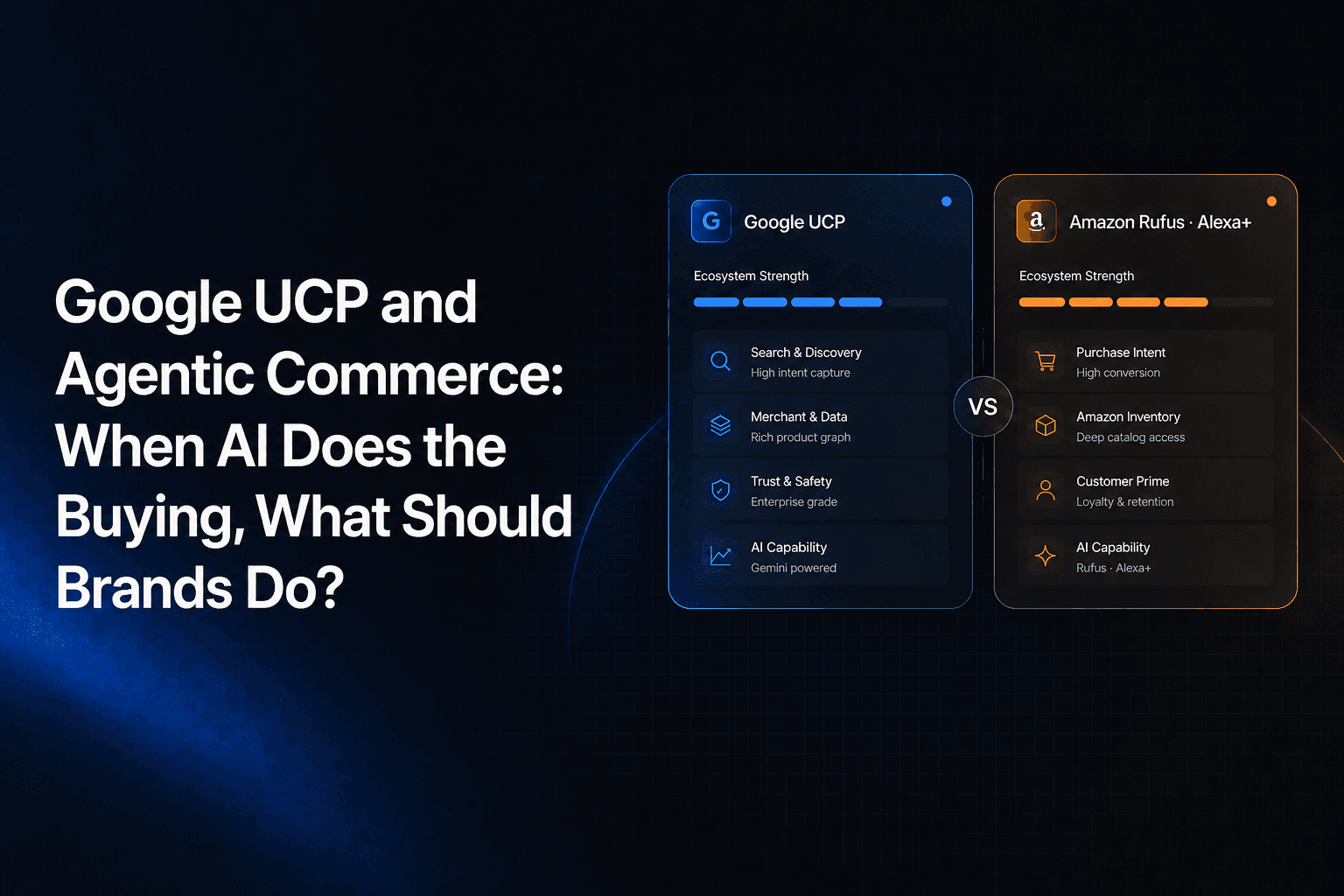
Side by side, the two camps' strategies make the contrast clear.
Dimension | Google UCP | Amazon Rufus / Alexa+ |
|---|---|---|
Strategic model | Open protocol — a retailer alliance | Walled garden + simultaneous UCP Tech Council seat |
Agent surfaces | Google AI Mode, Gemini | Rufus, Alexa+, Alexa.com |
Payment / checkout | Google Pay + retailer payment rails | Amazon Pay + Buy for Me |
Key partners | Shopify, Etsy, Target, Wayfair (founding) + Amazon, Meta, MS, Salesforce, Stripe (Tech Council, 4/24) | Expedia, Yelp, Angi, Square (Alexa+ direct integration) |
What brands must do | Schema.org · Merchant Center · UCP onboarding | Seller / Vendor Central · A+ content · Rufus exposure |
When it hits Korea | Immediately — Google, Gemini and Merchant Center are already in Korea | Limited — no direct Amazon retail in Korea; relevant only to K-brands going global |
In the end, what brands need to prepare for isn't “pick one” — it's “be readable to both”. The Google side is reached via Schema.org, Merchant Center and UCP onboarding paths; the Amazon side via Seller Central, Vendor Central, A+ content and Rufus exposure shaping. Both demand the same two underlying things: product data consistency and brand authority assets. Villion is built on that common layer, surfacing readiness against both camps on a single dashboard.
Korean market view — prioritize Google
Korean consumers barely use Amazon. The Korean e-commerce market is held by Coupang, Naver Shopping, 11st, Gmarket, Auction and SSG.com — and there is no direct Amazon retail service in Korea. Alexa, Alexa+ and Rufus are not officially available in Korean. As a result, the surfaces Korean consumers actually touch when exploring products via AI agents are Google Gemini, Google AI Mode, ChatGPT, Perplexity, Claude and Naver AI Summary.
So for Korean D2C and B2B brands, the agentic commerce priority is clearly the Google UCP side. Amazon work has strategic value only for (1) K-brands expanding into the U.S., Europe and Japan via Amazon Global Selling, and (2) global beauty, fashion or food brands whose overseas customers will explore them through Rufus or Alexa+.
Korean brands should pair that with Naver's AI moves. Naver is strengthening AI Summary (AI Briefing) on search and AI curation in Naver Shopping, and Naver remains the single biggest gateway to Korean traffic. The most realistic dual play right now is treating “Google UCP + Naver AI” as one set, and adding Amazon later as a separate phase when expanding globally.
The three stages of agentic commerce
UCP defines the customer journey as Discovery → Buying → Post-purchase, specifying what the agent should do and what data the retailer should expose at each stage. Translated into operator-level terms, here's what each stage looks like.
01 Discovery: the agent finds your brand
Users no longer click blue links on Naver, Google or Daum. They type natural language into Gemini 2.0 Pro, ChatGPT, Perplexity, Claude or Microsoft Copilot — “recommend a hydrating toner for sensitive skin” — and the AI compresses the field down to a shortlist of brands and products. If you're not picked at this stage, no transaction follows. This is the choke point of the zero-click era and the funnel inlet for all of UCP.
Checklist
Apply Product/Organization/Offer JSON-LD to brand and product pages (Schema.org standard)
Reorganize specs, ingredients, usage and sizing on product detail pages as AI-readable tables
Explicitly allow AI crawlers (GPTBot, PerplexityBot, ClaudeBot, Google-Extended) in robots.txt and llms.txt
Measure brand citation rate and Share of Voice in answers for priority long-tail queries
Monitor rank and mention sentiment against competitors inside AI answers
02 Buying: the agent completes the purchase inside the conversation
The real inflection unveiled at NRF 2026 lives here. The user completes payment without ever leaving ChatGPT or Gemini. The agent uses UCP's Catalog capability to look up the retailer's real-time variants, inventory and pricing, and Identity Linking applies the logged-in user's membership tier, loyalty points and coupons to the final price. Payment runs through UCP-compatible channels including Google Pay.
Checklist
Ensure product catalog data is consistent in real time (variants, inventory, pricing)
Complete Merchant Center feed fields — GTIN, MPN, brand, availability
If you operate on Shopify, Etsy, Wayfair or Target (founding) — or endorser platforms like Walmart, Best Buy, Macy's — verify your UCP integration path
Audit Google Pay and local Korean PG integrations (Toss Payments, KG Inicis, NICE Payments)
Prepare cross-border, multi-language and multi-currency routing rules
03 Post-purchase: the agent handles support and re-purchase
UCP bundles delivery tracking, refunds, exchanges and re-purchase flows into the same protocol. If your order, CRM, shipping and CS data aren't connected at this stage, the customer experience fragments and you lose re-purchase opportunities and LTV. Worst of all, with no loop to detect and correct 'misinformation the agent gave the user,' your share of voice erodes over time.
Checklist
Keep order/shipping status APIs consistent with CS channels (KakaoTalk channels, email, in-app chat)
Redesign loyalty, membership and points systems with UCP Identity Linking in mind
Make re-purchase triggers (replenishment, seasonality, bundle proposals) legible to agents
Build a real-time loop to detect and correct false product info the AI gave out
Structure reviews, ratings and UGC via Schema.org Review/AggregateRating, kept current
GEO → UCP: what to prepare next
UCP sits on the extension of GEO. For an agent to choose your brand as a transaction counterparty, AI first has to know you, then has to cite you, and only then can it transact. Break the chain anywhere and the UCP integration doesn't translate to outcomes. The preparation order between GEO and UCP splits into three layers.
LAYER 1: GEO base (AI legibility · authority)
Product/Offer/Organization/BreadcrumbList/FAQPage JSON-LD applied consistently across all pages
Zero structured-data errors via Google Rich Results Test and the Schema.org validator
Allow GPTBot, PerplexityBot, ClaudeBot and Google-Extended via llms.txt, robots.txt and sitemap.xml
Measure brand citation, Share of Voice and sentiment on the priority long-tail queries
Aggregate weekly competitor rank and recommendation tone inside AI answers
LAYER 2: Catalog consistency (the product data layer)
Real-time sync of inventory, price and variants across your own store, marketplaces (Coupang, Naver Smart Store, 11st) and ERP
A fallback path so out-of-stock or discontinued items are flagged or substituted in AI responses
Standardized attributes on key product categories (color, size, volume, ingredients, skin-type fit, and so on)
Full Merchant Center feed quality — GTIN, MPN, brand, availability, shipping
Reviews and ratings exposed via Schema.org Review/AggregateRating
LAYER 3: UCP onboarding readiness (the agent transaction layer)
Audit Google Merchant Center account and feed quality, and check UCP onboarding eligibility (Merchant Center — UCP onboarding)
Map the UCP integration roadmap for Shopify, your own stack and ERP — and clean up internal tech debt
Pre-assess whether loyalty, membership and CRM data can connect to Identity Linking
Map payment routes — Google Pay, Toss Payments, KG Inicis, NICE Payments, and so on
Document refund, exchange and dispute SLAs plus CS scripts in a form AI can read
Strategic choices for SMB and mid-market brands
The big players are already inside UCP's early partner list. Tech Council founding members (Shopify, Target, Wayfair, Etsy) lead, and ~20 global retailers (Walmart, Best Buy, Macy's, and others) endorse from behind. With Amazon, Meta, Microsoft, Salesforce and Stripe joining the Tech Council on April 24, governance involvement has only widened. SMB and mid-market brands don't need to fight that battle head-on. The opportunity sits in long-tail agentic queries.
On queries with specific context — “hydrating toner for sensitive skin,” “a quiet wine bar near Gangnam Station for an evening with friends,” “corporate card that fits a Pangyo startup” — AI actually prefers niche brands. ChatGPT, Perplexity, Gemini and Claude are trained to avoid the obvious answer and find the one that exactly matches the conditions. Brands that achieve the state of “AI actually picks us as the real answer” in these areas first will be the fastest to convert through to transaction when UCP goes mainstream.
Recommended execution cadence, in three quarters. 0–3 months: clean up structured data, llms.txt and robots.txt; measure citation for priority queries. 3–6 months: harden catalog consistency and review data; build content authority assets (guides, comparison tables, case studies). 6–12 months: prepare UCP onboarding through Merchant Center and Shopify; design Identity Linking integration. Follow this order and you won't fall behind when UCP goes fully mainstream.
Related reading — What is GEO?, Five conditions for the zero-click era, E-commerce AI visibility strategy, Why SEO matters more in the GEO era.
Frequently asked questions
What is the Universal Commerce Protocol (UCP)?
UCP is an open standard for 'agentic commerce' that Google CEO Sundar Pichai unveiled on January 11, 2026 at the National Retail Federation's 'Retail's Big Show' (Javits Center, NYC). It is designed to let consumers, AI agents, retailers and payment networks speak the same language — so users can complete a purchase inside an AI conversation like Google AI Mode or Gemini. The original Tech Council founding members were Google, Shopify, Etsy, Target and Wayfair, with another ~20 retailers, payment networks and platforms (Walmart, Adyen, American Express, Best Buy, Flipkart, Macy's, Mastercard, Stripe, Home Depot, Visa, Zalando, and more) endorsing it. On April 24, 2026, Amazon, Meta, Microsoft, Salesforce and Stripe joined the Tech Council, expanding it to 16 seats. UCP onboarding rolls out gradually via Merchant Center.
Do SMB and mid-market brands need to prepare for UCP?
Yes, even more so. UCP is an open spec, so it isn't a league reserved for large retailers. Google has said Merchant Center will roll out a 'Simplified UCP onboarding' path, which means D2C brands on platforms like Shopify, Cafe24, Imweb and NHN Commerce can be brought in over time. The point is to get product catalog, structured data (JSON-LD Product/Offer) and identity (loyalty, CRM) in order ahead of time so the agent can correctly understand, recommend and purchase your products. Given rising ad costs and the spread of zero-click search, this is the one organic channel SMBs must claim early.
How does UCP connect to GEO (Generative Engine Optimization)?
GEO is the layer where AI is made to cite and recommend your brand. UCP is the layer above where AI directly chooses you as a transaction counterparty. The two stack: for ChatGPT, Perplexity, Gemini, Microsoft Copilot or Google AI Overview to bring your brand out as the answer to a query, you first need structured data and content authority. UCP's Catalog, Identity Linking and Direct Buying sit on top of that, completing the agentic transaction. Wire up UCP without a GEO foundation and the conversion never starts — because you weren't on the recommendation list to begin with.
What can we do right now?
Start with five things. (1) Verify that variants, inventory and pricing in your product catalog stay consistent in real time across your own store, marketplaces and feeds. (2) Use Google Rich Results Test to verify that Product/Offer/Organization/BreadcrumbList/FAQPage JSON-LD are applied to every page per Schema.org. (3) Update llms.txt, robots.txt and sitemap.xml so AI crawlers (GPTBot, PerplexityBot, ClaudeBot, Google-Extended) are explicitly allowed. (4) Measure how your brand and products actually appear in Google AI Mode, ChatGPT, Perplexity and Gemini. (5) Internally assess whether your loyalty, membership and order data can connect to UCP's Identity Linking. Villion supports (4) out of the box.
Once UCP goes live, how does it affect users of Korean platforms like Shopify and Cafe24?
Shopify joined as an early official UCP partner. That means Shopify-based Korean D2C brands stand a good chance of being auto-onboarded onto the UCP path simply through platform updates. Cafe24, Imweb and NHN Commerce aren't on the official early-partner list yet, but because UCP is an open spec, brands that keep Merchant Center feed consistency and Schema.org structured data clean are likely to be brought in along a similar path. The thing that matters more than the platform is getting a 'product data layer the agent can read' in order first.
Is Amazon participating in UCP?
On April 24, 2026, Amazon joined the UCP Tech Council together with Meta, Microsoft, Salesforce and Stripe — shifting the early picture from 'Amazon is out' very quickly. With the original founding members (Google, Shopify, Etsy, Target, Wayfair), Council seats expanded to 16, and Amazon now has direct influence over protocol direction and the codebase. That said, Amazon hasn't dialed down its own walled-garden lineup: (1) Rufus — the in-app AI shopping assistant, passed 250M users in 2025 with MAU +149% and interactions +210%; (2) Alexa+ — general availability in the U.S. in February 2026, $19.99/mo (free for Prime), autonomously browsing the web to book, buy and order service; (3) Buy for Me — agentic checkout completing payments on other brands' sites from inside the Amazon app, supported products expanded from 65,000 to 500,000+. In other words, Amazon is running a two-track strategy of joining the UCP standard while also being its own agent hub — so brands still need to address both camps.
Should brands prioritize Google UCP or Amazon first?
It's not either-or — you need a ticket to both. Google UCP requires AI-readability assets like Schema.org structured data, Merchant Center feed consistency and AI-crawler accessibility (llms.txt). Amazon requires quality on Amazon Seller Central / Vendor Central product detail, reviews and A+ content, plus visibility shaping inside Rufus and Alexa+. The common denominator is product-data consistency and content authority. The realistic plan is to harden the GEO base on your own site first, then manage Google UCP exposure and Amazon Rufus / Alexa+ exposure in parallel as a dual-track program.
Do Korean brands need to worry about Amazon Rufus and Alexa+?
If you serve only the Korean domestic market today, the practical Amazon impact is very limited. Amazon doesn't run direct retail in Korea, and Alexa, Alexa+ and Rufus don't have official Korean-language services. When Korean consumers explore products via AI agents, the surfaces they actually touch are ChatGPT, Perplexity, Google Gemini, Google AI Mode, Claude and Naver AI Summary — so the priority for Korean brands is Google UCP + Naver AI. That said, two cases call for Amazon work as a separate step: (1) K-beauty / K-fashion / K-food brands expanding into the U.S., Europe and Japan via Amazon Global Selling, and (2) global D2C brands whose overseas customers may explore them through Rufus or Alexa+ — both should manage Amazon Seller Central / Vendor Central exposure and A+ content quality.
Primary references
How does your brand show up in AI answers?
Get a brand audit- Insights
Villion
GEO AEO 종합 솔루션 빌리온입니다.
Explore with AI