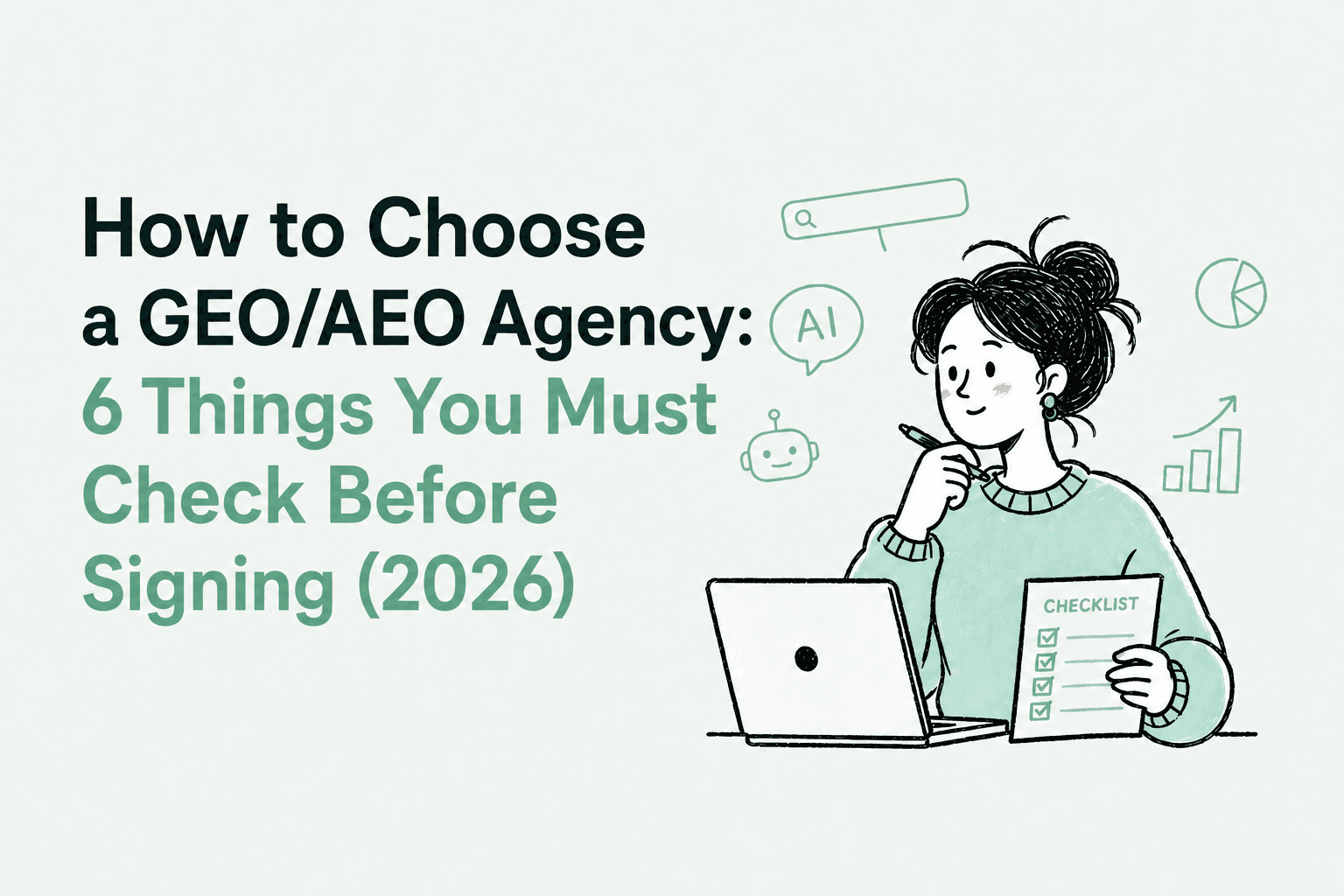
Key takeaways from this article
A good GEO agency explains performance not with a single screenshot from a manager’s account, but with results from repeatedly measuring the same questions in a clean environment with no history.
It also goes beyond publishing content and improves your website’s SEO and technical structure together. Before signing, you must check the measurement method, the basis for choosing content topics, site diagnosis capability, SEO competency, and ownership of the domain and data.
When they say, “We searched and you show up great”
When a GEO agency reports results, you may run into a situation like this.
The agency’s person opens their laptop and types a question into ChatGPT. Our brand name appears in the answer.
“See? You’re already showing up well. We created these results.”
At that moment, there’s a question you must ask.
“Which account did you search from?”
Some AI services, including ChatGPT, can reflect a user’s chat history, saved information, and personalization settings in their answers. If the manager repeatedly searched for our company or had related conversations in the same account, that history could influence the response.
On top of that, there are two more variables.
First, AI answers can vary every time. If you enter the same question multiple times, the frequency of brand mentions and the content of the answer can change. One appearance alone is not enough to judge it as stable visibility.
Second, results can also change depending on access location, language settings, the model, and the timing of the search.
So a single screen checked in a manager’s account is not enough to determine how much our brand is actually being surfaced across the broader market.
This article organizes the questions you should verify before signing, so you can validate these kinds of proposals. You can use it as-is when meeting multiple agencies.
Villion also provides a GEO solution. Precisely because of that, we believe we have a responsibility to clearly explain the standards customers should use to evaluate a GEO agency.
What does a GEO agency do?
GEO stands for Generative Engine Optimization—optimization for generative engines.
It’s the work of getting AI services like ChatGPT, Perplexity, and Gemini to discover our brand and products when answering user questions, use them as supporting evidence, and mention them in the right context.
For GEO to work properly, the following four steps must be connected.
Stage | What you do | If this stage is weak |
|---|---|---|
1. Measurement | Record current brand visibility for questions customers actually ask | No baseline, so you can’t judge later performance |
2. Diagnosis | Analyze why the brand doesn’t appear—across site, content, and external trust | Time and budget get spent on low-impact tasks |
3. Execution | Improve site structure and produce the necessary content and information | Only reports pile up while the actual site doesn’t change |
4. Re-measurement | Measure again under the same conditions and compare before/after changes | You can’t tell which actions were effective |
The problem is that agencies differ in how much of these four stages they cover. But their decks may all say “GEO solution.”
The six questions below are criteria to verify how far an agency can actually go across those stages.
Q1. Who owns the domain and the website?
If website build-out is included in the contract, this is the first item you should check.
Why does it matter?
Most assets created through search and GEO accumulate on the domain.
Pages indexed by search engines, content discovered and cited by AI search services, links earned from external sites, and search performance history are all tied to the domain.
If the domain changes, search indexing, external links, and existing page evaluations can be heavily disrupted. Without proper migration, you may lose a significant portion of the search assets and visibility you’ve built up.
In particular, some web build agencies register the domain under the agency’s name rather than the client’s. It may seem fine during the contract period, but when you switch providers or end the contract, the domain can become a bargaining chip.
What should you ask?
“Will the domain registrant be under our company name?”
Managing a domain on your behalf and owning the domain are completely different things.
“Do we directly hold the domain management account?”
The client must directly own the account and access to the domain registration service.
“What is the domain and website transfer process when the contract ends?”
Transfer terms and procedures must be written into the contract, not just explained verbally.
You should also confirm where the site is being built
Some agencies build your website or blog on their own platform. It’s easier to manage, but after the contract ends it may be difficult to migrate content and data to another system.
Also, if the blog is created on a separate address rather than the client’s official domain, there’s a risk your search assets get fragmented.
The criterion is simple.
After the contract ends, can the client still retain the domain, website source, content, and data as-is?
If you can’t take even one of the four, it’s closer to renting the agency’s system than owning a client asset.
Q2. How and how often do you measure performance?
GEO performance should not be judged by a one-time search result from a manager’s personal account.
AI answers are generated probabilistically, and results can vary by the question environment. So you must keep measurement conditions consistent and check repeatedly.
Conditions required for proper measurement
Condition | Why it’s needed |
|---|---|
An environment that minimizes history and personalization effects | To reduce the influence of existing chat history on results |
Repeated measurement of the same questions | To distinguish a one-off appearance from consistent visibility |
Measurement on a fixed cadence | To compare past and current results under the same conditions |
Measurement across multiple AI engines | Because results differ across ChatGPT, Perplexity, and Gemini |
Storage of original answers and measurement logs | So the client can directly verify scores and results |
What should you ask?
“How many times do you repeat the measurement for the same question?”
If there’s no repetition count, they may only be checking a single search result.
“Can we see the original answers the AI actually generated?”
If they only provide scores and graphs, it’s hard to verify which answers those scores came from.
“Which AI engines do you enter how many questions into, and on what cadence?”
The model used for measurement, number of questions, number of repetitions, and measurement cadence are basic conditions for interpreting performance.
“Is the measurement environment a manager’s personal account?”
If they use a personal account and chat history as-is, results may be distorted.
Why you need to see the original answers
The mere fact that the brand was mentioned is not enough.
It means something completely different depending on whether the AI presented our brand as a recommended product, merely included it in a list, or mentioned it as a cautionary example.
So you should review not only mention rate but also the context of the mention and the cited sources.
Q3. What is your basis for choosing content topics?
GEO contracts often include content production and publishing.
There’s something you must clearly distinguish here.
Content volume is a contract condition; content topic selection is strategy.
A common answer
“We’ll publish four blog posts per month for you.”
What’s missing in that answer is what they’ll write and why.
A good answer
“Of the 50 questions we measured, our brand doesn’t appear in 12. Among those, we’ll address five first—questions with high purchase intent that are close to actual customer inquiries. After publishing, we’ll re-measure the same questions to confirm the change.”
A good content strategy starts from current measurement results and customers’ real questions.
That way, after publishing, you can verify which questions saw increased brand visibility.
What should you ask?
“What process do you use to decide next month’s content topics?”
Since it’s before signing, they may not provide exact titles, but they should be able to explain the criteria and process for choosing topics.
“What’s the rationale for choosing those topics?”
Choosing topics based only on search volume is insufficient. High-volume keywords may not match real customers’ purchase questions.
“How do you verify impact after publishing?”
You need to confirm whether they re-measure the same questions after publication.
If the topic selection criteria remain vague to the end, be careful. Content produced without evidence can leave you with only published post counts—without changes in real AI answers or customer acquisition.
Q4. Can you identify issues we need to fix on our site right now?
“We’ll increase AI visibility without touching your site.”
It can sound appealing because it seems to remove development burden. But if the site isn’t properly readable by search engines and AI crawlers, there’s a limit to what you can achieve just by increasing content.
Generative AI search optimization is not separate from traditional search optimization. AI search services find relevant documents on the web based on the question and then construct answers using what they discover.
In that process, if our pages don’t get found in search or the content isn’t read properly, the likelihood of being used as evidence in AI answers also decreases.
Issues that are commonly found in practice
Common issue | What it causes |
|---|---|
Pages not indexed by search engines | Hard to be discovered in search results and AI search |
Interfaces dependent on JavaScript | Visible to humans, but the HTML collected by bots may lack content |
Product detail pages as a single image with no text | Search engines and AI struggle to read product descriptions and features |
Crawler-blocking settings | Search bots may not be able to access even public pages |
Duplicate page URLs | The evaluation of the same content gets split across multiple URLs |
Lack of structured data | Hard to accurately convey page meaning such as product, price, inventory, reviews |
Weak internal linking structure | Hard for search bots and users to find important pages |
Unclear title and body structure | Hard to determine which question the page answers |
What should you ask?
“Please explain the top three issues we should fix first on our site right now.”
If they reviewed your actual site before the meeting, they should be able to explain at least a few concrete issues.
If they repeat only generic statements without even opening the site, they may be selling a fixed package rather than performing a diagnosis.
Q5. Can you handle SEO strategy and execution together?
GEO is not a replacement for SEO.
For your brand to be discovered in AI search, search engines and AI must first be able to find, read, and understand your site. So when choosing a GEO agency, you should also verify their understanding of SEO and their ability to actually execute it.
Questions to ask
“Do you also work on technical SEO and content SEO?”
“To increase visibility for the core search terms related to our brand, what pages and content would we need?”
An agency with SEO experience and execution capability should be able to connect and explain the following items.
Analysis of customer search intent and questions
Research on core keywords and detailed questions
Design of site menu and page architecture
Planning of product, service, comparison, case study, and FAQ pages
Improvements to titles, H tags, and metadata
Internal linking and sitemap setup
Implementation of structured data
Fixing indexing and crawling issues
Measuring the connection between search performance and AI visibility performance
On the other hand, be cautious if you hear answers like this.
“GEO is completely different from SEO, so you don’t need any SEO work.”
There are clearly additional metrics and execution methods to measure in GEO. However, the fundamental structure for being discovered and cited on the web is closely connected to SEO.
Check #6. What remains after the contract ends?
The assets created through GEO work should not function only during the contract period.
The improvements applied to the site, the content published, and the measurement data and diagnostic results should remain with the client even after the contract ends.
Items you must verify
“Who owns the copyright to the content that was published?”
If content was produced at the client’s expense, the scope of usage rights and ownership should be confirmed in the contract.
“Can we receive the data you’ve measured as files?”
You should be able to export the question list, original answers, mention rate, citation sources, and time-series change data.
“Do the configurations applied to the site depend on your system?”
Confirm whether improvements are maintained only via the agency’s server or scripts.
“Do the improvements applied to the site remain even after the contract ends?”
If the site reverts to its previous state as soon as the contract ends, it’s hard to view it as a long-term asset for the client.
After the contract ends, at minimum the following items should remain with the client.
Domain and management account
Website and source code
Published content
Images and production materials
Measurement question list
Original AI answers and performance data
Site diagnosis results
Applied SEO and structured data configurations
If you hear these lines, double-check
“We searched in our account and you show up well”
A single screen checked in a personal account is not performance measurement. You should ask under what environment and how many times they measured.
“We guarantee #1 in AI search”
AI answers are not a fixed ranking table like standard search results.
You can measure mention rate, recommendation position, and citation sources, but it’s difficult to guarantee being #1 for a specific question at all times. You should verify what they define as “#1” and based on what criteria.
“You don’t need to touch the site”
If the site isn’t readable by search engines and AI crawlers, it’s hard to solve with content and external work alone.
“We’ll publish X posts every month”
More important than the number of posts is which questions you’re targeting, why you chose those topics, and how you verify impact after publishing.
“Our measurement method is proprietary, so it’s hard to disclose”
Internal algorithms and scoring methods can be trade secrets.
But for performance verification, they must be able to disclose which AI engines they measure on, how many questions, how many repetitions, and on what cadence.
They don’t clearly explain domain ownership and the transfer process
The domain registrant name, management account, and post-contract transfer procedure must be included in the contract.
Frequently asked questions
Do we have to use a GEO agency?
Not necessarily.
If you have someone in-house who understands SEO and website structure, and you have resources to continuously produce content, you can do it yourself.
Cases where an external agency is particularly helpful include:
When you don’t have a system to repeatedly measure answers across multiple AI engines
When it’s difficult to diagnose the site’s technical issues yourself
When it’s hard to secure development resources
When it’s hard to run measurement → diagnosis → execution → re-measurement as one process
Why isn’t it enough that the brand appeared after a single search?
AI answers can vary each time even for the same question.
Appearing once means it appeared in that particular environment, not that it will be stably surfaced to real customers.
To judge performance, you must measure the same question multiple times and check how often the brand is mentioned across all answers. You should also compare to the previous measurement period to see whether the mention rate increased.
What if the domain is already registered under the agency’s name?
First, check the current registrant and the management account in the domain registration service.
Then it’s best to request that the agency transfer the domain to an account under the client’s name. It’s much easier to handle while the business relationship is still smooth.
It’s also safer to keep the transfer procedure and required authentication information in writing.
How long does it take for GEO results to show?
Technical changes can be rechecked by search engines within days to weeks, depending on site size and crawl frequency.
However, it may take longer for AI answer mention rates and citation sources to change noticeably. Depending on site condition, content publishing pace, industry competitiveness, and the level of external mentions, it may take weeks to several months.
If they promise dramatic results from the first month, you should verify in detail which questions, which metrics, and what evidence indicate the change.
What contract term is reasonable?
To validate initial measurement, diagnosis, site improvements, content publishing, and re-measurement, you typically need a verification period of around three months.
However, rather than signing a long-term contract from the start, it’s safer to set goals, scope, deliverables, and evaluation criteria for an initial period, verify results, and then extend.
Our industry seems to have low demand for AI search yet
Some industries may indeed not have large search volume yet.
In that case, rather than starting a GEO contract unconditionally, it’s better to first investigate what questions real customers ask in AI. You should confirm question volume, purchase intent, and competitor brand visibility before deciding investment priority.
Low competition can be an opportunity, but you should avoid increasing workload before confirming sufficient demand.
Final pre-contract check
A good GEO agency isn’t one that simply publishes lots of content or shows a screen where your brand appears in a manager’s account.
They must be able to answer the following questions concretely.
Are the domain and website owned by the client?
Under what conditions do you repeatedly measure AI visibility?
What data and questions do you use as the basis for choosing content topics?
Can you actually diagnose and fix the site’s technical issues?
Do you have SEO strategy and execution capability?
After the contract ends, do the domain, content, configurations, and data remain with the client?
GEO results are created not by a single search screen, but when measurement, diagnosis, execution, and re-measurement repeat.
Before signing, rather than asking “What will you do for us?”, ask this first.
“By what criteria do you find problems, what will you change, and how will you prove the results?”
How does your brand show up in AI answers?
Get a brand audit- GEO
- AEO
- SEO
- how to choose geo agency
- geo agency

Villion
Villion untangles GEO, AEO, and SEO.
Explore with AI